Search This Blog

Showing posts with label retro games. Show all posts

Wednesday, May 25, 2011

Retro Review: Syberia PC

Syberia is 20 years old now but pretty much as soon as it was released it was considered an instead classic.


Introduction

American lawyer, Kate Walker goes to France to sign some paperwork giving a large client control of an old toy factory. When she arrives she discovers a town full of strange but beautifully intricate automatons and a half century old secret. Suddenly a one day trip to take care of a few formalities becomes a life changing adventure aboard a clockwork train  heading for the fabled island of Syberia.


Syberia Title Screen Screenshot


Overview

Controls aren't bad, it's a point and click so there's not a whole lot of guessing or wondering how something is done. However Kate can be kind of sluggish sometimes, watching her take the stairs was particularly annoying for me but did make me nostalgic for those old PS1 adventures games that suffered the same issue. Additionally looking for the right sweet spot to make something work or pick up a necessary item got tiresome sometimes, but nothing any adventure game player shouldn't be very familiar with.


Syberia Aralbad Snowy Fountain Screenshot


Graphically it's nice overall. The character designs are pretty consistent with the time period though their movements themselves are bit stiff. The environments are imaginative and beautifully rendered with gorgeous art-nouveau and steampunk styling throughout, even the menu is pretty. My small issue is while they're lovely, the environments are pretty flat there's usually not a lot of background activity happening and you usually only see everything from one angle.

Soundwise it's good, but not phenomenal. It's got full voice-overs which normally in a game of this type I could take or leave, but other than a few
botched accents the voice actors were very believable.The only issue there was that it was the voices were often delayed, making many conversations awkward sounding especially when one character broke into another's speech or was supposed to be startling.

Syberia Pipe Organ Screenshot

The music, was well written and appropriate, but I had a problem with it's usage. Every single time you accomplished a task like turning something on or putting something together, you got a big swell of music. Which was ok the first time and maybe even the 10th time, but after that I was completely over it. It drowned out any background noise or conversation for those couple of minutes you were stuck listening to it. It at least had the decency change depending on your area, but it still got old quickly, which honestly is kind of a shame because the music was otherwise a high point.

Gameplay

As a point and click style adventure, your primary means of going through the game is talking to NPCs, finding important documents, finding random objects, using said random object with information obtained from NPCs and documents to complete a task and move on with your game. Simple classic stuff here, not too much different from the sort of things we were playing back in the eighties (King's Quest anyone?) it just looks nicer.

Syberia Voralburg Key Screenshot


The exploration leaves a bit to be desired. The locations are lovely and pretty well realized, but as I noted above they're a bit flat. Most places you can only see from one angle and there isn't really a lot of room to wander around. You're always on a main path that will take you to a puzzle or objective, sightseeing off the beaten path isn't an option. Additionally, Kate often wouldn't speak to NPCs that weren't absolutely necessary, or examine and comment on her environment unless it was relevant to the story right then. This sort of thing is a huge pet peeve of mine in any adventure game, as I feel extraneous environmental details, while unimportant to storyline, add to the depth and overall feel of a game. I will say however, that in some ways this detraction is also a blessing in some ways. As I mentioned briefly above, Kate walks painfully slowly even when running. I often found myself dreading any backtracking I had to do, so having full run of the land might not be so great. On the other hand, I'm playing an adventure game because I want an adventure I can feel connected to and immersed in, not a carnival haunted house style experience on rails.

Syberia Village Screenshot


I can't discuss the puzzles in any detail without ruining things, but they're pretty easy for a veteran gamer, not so easy they insult your intelligence though. Even if you're not an experienced game adventurer, they're not so hard you find yourself wanting to send the programmers some less than complementary emails. Most solutions are either discussed somewhere or by someone or are pretty logical once you have all the required items. I only found a few places where I got stuck because the next course of action wasn't exactly logical or ever discussed, but not really anything out of the ordinary for this type of game.

Syberia I need a Key

The storyline is interesting and compelling, Kate spends most of the game trying to track down the mysterious heir, master automaton maker and mammoth obsessee, Hans Voralburg. Tracking Hans is no easy task as by all accounts no one has seen him for years, and some think him long dead. Her only clues are his now dead sister's notes and some of Hans' creations including a clockwork train, and Oscar the amazing automaton train conductor who's AI tends toward the neurotic with special attention paid to needless bureaucracy. The two of them encounter a large cast of colorful NPCs ranging from a hotel clerks and barge captains to a drunken astronaut and a world famous opera singer. Most of the NPC are pretty fleshed out as well with refreshingly non-archetypal personalities. Even the locations themselves have interesting and complex histories for Katie to learn about.

Syberia Conversation Screenshot


Kate Walker's own personality comes through surprisingly natural character development. You learn about Kate's life via a series of cell phone conversations with her mother, best friend, fiancee, and boss. A nice change from the normal "my name is ___ and here's my life story" randomly blurted out in a cutscene found in many lesser quality games. By the end of the game I found myself thinking of Kate not quite as friend, but still fondly and familiarly, like an old high school acquaintance I would like to catch up with over coffee.

Syberia Kate on Train


They only issue with the storyline is the ending. Without ruining any details, it's abrupt, anti-climatic and clearly a lead-in to a sequel. Personally I can't stand it when game publishers (or movie makers, or novel writers) do that instead of giving you a real ending, there are ways of both giving your story and end that won't make your players feel like they wasted hours for nothing and still leave your options open for a sequel. I didn't necessarily feel like I wasted my time at the end of Syberia, but I did feel a bit cheated.

Syberia Train Screenshot


Conclusion

Syberia is a good game, it's got a nice classic feel and a unique, compelling storyline. Visually it's treat, every single object, environment and menu has been carefully and artfully designed and well rendered especially for the time period. The game isn't without it's flaws, as discussed above, but the positives outweigh them. So, if you've got a few hours to spare and are looking for a unique adventure Syberia won't disappoint.

~Stephanie

Don't forget to stop by our shop:

Tuesday, September 21, 2010

Retro Review: Banjo Kazooie N64

Today's retro review is a very special guest review by the surprisingly porous, retro game enthusiast, Dex. (good friend of regular contributor Richard/RM)

-Introduction-

Ah, Banjo-Kazooie. It isn’t possible for me to play this game and not feel waves of nostalgia for 1998 and being a mere 8 years old. A time where everything was simpler. Everything, except for the games. It seems the further back in time you go the more complex games seem to become. Are there games that are complex and difficult today? Sure, but they don’t seem to be in as much abundance as they are when you deal with consoles like the SNES or Genesis.

And even though our old games will often kick our asses if we aren’t fully prepared for them, we still look back on them with fondness. Maybe it’s because it reminds us of that simpler time? Maybe it’s those old school blocky graphics that remind us how things used to be. Who knows?

All I know is: I love Banjo-Kazooie


-Overview-

The basic idea behind Banjo-Kazooie is simple, you run around and collect stuff. The more stuff you collect the further you progress into the game. This mixed with 3D platforming ensures a fun, head scratching, and often maddening journey through Banjo & Kazooie’s world. The story of the game is that you are on a mission to rescue your sister, Tooty, from the evil witch, Gruntilda, who kidnaps her because she is so much prettier than her and is going use a machine to transfer all of Tooty’s good looks to her ugly disproportionate body. I didn’t say it was going to make sense, but if you don’t question a bear who houses a bird in a backpack he wears that helps him to fly you’ll go along with the story.


The graphics are bright and colorful, and very blocky by today’s standards. Unfortunately this is a reoccurring thing in all N64 games, they just have this blocky edge to them that is endearing for me but if you were to show it to some ignorant little 14 year old who plays nothing but Call Of Duty he would likely tell me that “These graphics suck” and ask me “why would anyone want to play this game” to which I would reply “punch to the face Timmy, punch to the face.”

The Sound design and Music in this game are, as expected with Rareware N64 games, excellent. There isn’t a sound effect that seems out of place or unwanted, and the music is catchy and memorable. It was so catchy and memorable in fact that it made up 90% of the music on that new Banjo-Kazooie game on the Xbox 360. How do I feel about that? We’ll come to that later.

The controls are, admittedly, a little complex, and will often send our heroes plummeting to their imminent death.


Pushing the control stick will make Banjo run/walk. The C buttons move the camera, B attacks, A Jumps, Z crouches. The shoulder buttons? Nothing. Seriously, why are those even there?

Sound simple so far? Let me introduce you to the basic move set.

Z and A backflips, which will be used many a time to get to a place where a standard jump just doesn’t cut it.

Pressing A shortly after jumping will cause Kazooie to flap her wings a bit and give you some more air time.

Z and B does the “Beak Barge” which is a sliding attack.

Jumping and then pressing B directly afterward performs the “Rat-A-Tat” which is an airborne pecking move.

Pressing Z and then left C will make Kazooie do all the leg work and enable you to get up slippery surfaces Banjo just can’t.

Pressing Z and right C makes you invincible using Kazooie’s wings as a shield (it just does, okay?).

Pressing Z and up C will make Kazooie to fire eggs in front of you.

Pressing Z and down C causes her to drop and egg behind you, complete with it’s own fart sound effect.

I love this game.

- Gameplay-

In the beginning of the review I said that you collect “Stuff”. What I did not highlight is exactly how much “stuff” you will be collecting. The short answer? A shit-ton.

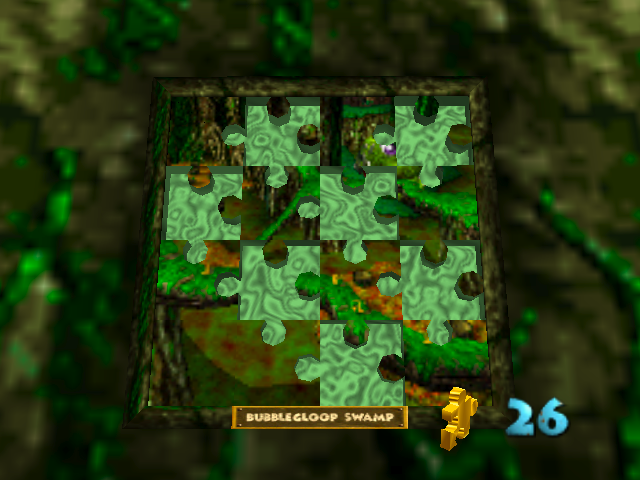
The long answer? Do I really have to? Okay. It works like this. The main “thing” you collect is called a Jiggy (aka Jigsaw Piece). You use the Jiggies to fill in puzzles you find in Gruntilda’s lair (the main hub of the game) that open up different worlds so you can collect more Jiggies. You’ll also have to collect Musical notes to break the Note doors that are scattered around the lair that guard more Jigsaw Puzzles and more worlds.

Those are the two “Main” things you have to collect. Other things include Eggs, Feathers (of the Red and Gold variety), Jinjo’s (of which there are 10 in each level. Collecting them all bags you another Jiggy), Silver Skulls (that you give to the resident shaman “Mumbo” who will turn you into some kind of animal that will help you collect a specific Jiggy), Honeycomb Pieces (the equivalent of Zelda’s hearts, or coins in Mario 64), and Empty Honeycombs (like pieces of heart in Zelda, except six honeycombs make up a whole).

As you can see, there is rather a lot to gather up in this game, and that’s not including the extra lives (which are statues of Banjo in a heroic pose MADE OF GOLD), and by the end of it you’ll wonder exactly where Banjo keeps it all.


It is easy to be horribly misled by this game in many ways. The first is seeing the vastness of things that must be collected and thinking “surely I don’t have to collect EVEYTHING on EVERY level?” Do you see that picture up there? That is the SECOND note door. Let me repeat that for you. The SECOND. To put it into even more perspective, there are 100 notes in every level. By the time I had taken this picture I had opened 3 levels, collected 30 Jiggies, and 185 Musical Notes.

The other thing that will happen to most people who begin to play this game (and naïve little 8 year old me) is to see the amount of Jiggies in each level, is not equal to the amount needed to complete the Jigsaw puzzles. Your brain draws the conclusion that the collection of all 10 Jiggies in all 9 worlds (and the 10 in the lair that are revealed by finding the Witch Switches. Do the math) is not necessary and that you will simply collect the most obvious and easiest to reach Jiggies and progress through the game without any trouble…..


The above outlines how wrong you are, and just how cruel and unfair this game can be. And once you think you’re ready to take on Grunty, you would do well to remember the above picture. Do you really think the cruelty ends because you are at the end of the game? If you said yes, you are sadly mistaken. And so was I.


- Rage-Worthy-

Overall this game is an enjoyable and fun experience. And once your journey is over you will reminisce about the time you had with this game. Yes, overall this game will leave you smiling, for the most part.


The above picture is the epitome of unfairness. It is Mr. Viles, Grumblie eating contest. As you can clearly see from the score, I won. What you don’t see is that this is my second attempt. Mr. Vile’s Grumblie eating contest comprises of 3 rounds. The first round simply has you eating more red Grumblies than him.

The second round has you doing the same thing but avoiding the yellow ones as they are “not ripe yet”. The third and final round is the same premise but you must eat only what is shown as it alternates between Red and Yellow varieties.

What Mr. Vile does not tell you is that, even if you make it to the 3rd round, if you lose you will have to start the whole thing over. From round one. The other thing Mr. Vile does is that when you lose, and on the first try it is more than likely; he comes over to you and bites you, causing to lose some health.

As a child I had never experienced rage until this moment in my life.

I hate Mr. Vile with every fiber of my being. You are literally on the edge of your seat, your palms sweating, heart racing, you must beat Mr. Vile because he annoys you, you want to win so you can get that Jiggy (and in my case it was the LAST JIGGY IN THE LEVEL) and then you either lose by ONE point or you draw with him, which apparently constitutes as a loss in this world.

If you’re quick you can GTFO before he comes over and OM NOM NOMS on your ass but on the first try it ain’t gonna happen. You are robbed of your dignity and of a piece of health. Cruel and unfair.


In fact the whole level where Mr. Vile is located is just as frustrating comprising of timed dashes for Jiggies and a memory mini-game that ALSO causes you to lose health when you get it wrong.

There ARE levels that are more difficult than this one (this being level FOUR out of NINE). Rusty Bucket Bay is probably the most unfair level in the whole game, and Click Clock Wood is probably the most complicated level of the bunch.

But the ONE thing that players will always remember is the final fight with Gruntilda. There is a word that sums this up perfectly, Cluster-Fuck.

The end boss is the most cruel and unfair of all. You have worked your ass off collecting notes, Jiggies, eggs, and everything in-between, not to mention you just had to go through the whole “Gruntys Furnace Fun” ordeal, which is a quiz with questions about the game, and when you FINALLY have the confrontation with Grunty the game kicks your ass harder than it has the whole game. That’s probably why it is the most cruel and unfair thing of all. It’s the VERY LAST thing that stands between you and a completed game. And it is BALLS hard and not at all cool.

Why is it so hard? She flies at you so fast you barely have time to dodge out of the way, she throws fireballs that are also difficult to dodge, you have to try and hit her with eggs that are already awkward enough to aim whilst she throws those fireballs, there’s a high probability you will fall off of the tower the battle takes place on, flying in this game is not an easy thing to do so when it asks you to perform the “Beak Bomb” attack you learn later on (press B whilst airborne) things get messy, the flying is already awkward, and the beak bomb attack causes you to shoot forward very fast and then drop a little and if you don’t press A in time at the end of the attack, say goodbye.

Yes, it is a difficult boss fight, but when you finally beat Grunty it just makes the victory all the sweeter.


- Conclusion -

Here’s the upshot of this review: this game is not for the faint of heart. What appears to be a cute and unassuming game is actually what I would consider a cruel and unusual form of torture designed by kleptomaniacs. That may be so but the fact of the matter is that once you start to play, the overall charm of the game captivates you, it presents you with a silly story and a silly premise. The game does not take itself seriously and it knows it and wants you to be in on the fun.

Once you start playing, you feel compelled to keep going until the very end. Yes it gets annoying, yes it gets tiresome, but once you’ve cooled off for a bit, you’ll always want to come back for more.

Banjo-Kazooie went on to be a series of 4 games. 2 on the N64, 1 on the GBA (and a racing game), and 1 on the Xbox 360. How do I feel about the 360 game?

Much the same way as I do about this one, It’s silly, 4th wall breaking humor that’s a lot of fun, and even though the key platforming aspect was removed (in favor of vehicle building) I still find something in it that I can enjoy. And who knows? Maybe somewhere down the line (after they’re done with all this “Kinect” silliness) Rare will make that 3rd true Banjo game fans are dying for.


All I know is: I love this game. But the sequel? There aren’t enough words in the dictionary that describe how much I love the sequel. But I’ll give it a shot in my next review.

~Dex

Thanks for the guest review Dex!

Don't forget to stop by our shop for retro gaming collectibles:

Monday, July 19, 2010

Retro Review: Legends of Murder 2: Greyhaven

Greyhaven was one of my favorite games as a child, I was so happy to find that my old 3rd or 4th generation floppy of it still functions after 20 years, especially as for years it was not available for download anywhere on the Internet (though last we checked a few sites had it).

Introduction

Greyhaven is a fantasy murder mystery RPG published to Big Blue Disk magazine in 1991 (though the game itself was apparently made in 1990) which was a computing magazine solely for DOS games. It wasn't one of the most notable games to ever by published in Big Blue Disk (Like Apogees Kroz series, or ID Software's Catacomb series) But it is the one I remember most fondly from my childhood.


Legends Of Murder 2 Greyhaven Opening Screen


Overview

Legends Of Murder 2 Greyhaven OKeys

Controls are pretty simple keyboard controls arrows and simple keyboard controls (IE G brings up the game menus, S searches/looks etc.). They're pretty standard for a dos game of this type. However, the controls are clunky it's easy to get stuck on things and you sometimes have to search around a stationary object 10 times before you find an item you KNOW is there.


Graphics are fine. Graphics while you're moving around the map and interacting with things are quite sparse, graphics on the closeups are better, but really nothing amazing. Honestly though the graphics are a bonus this game easily could have been a text only.

Sounds are nonexistent. I suggest listening to something like Midnight Syndicate to set your own mysterious murder fantasy mood.


Gameplay

You start the game with text explaining why you've come to the sleepy little town of Greyhaven which you've apparently been to before. You are the inspector, a crime solving mage, who's continuing mission is to seek out new life and new civilizations, to investigate the murder of a wizardry School apprentice. You make your way to the local tavern to meet with the headmaster of the school. On the way there you can investigate the town or run straight to the Tavern.

Legends Of Murder 2 Greyhaven Tavern

Honestly though if you just want to dash through and not read and/or explore this probably isn't the game for you, as it's pretty much the entire game play. When you do investigate you'll notice that things in the town are...a little off. Boarded up businesses, abandoned homes, deserted streets and naturally some unhappy creatures bent on killing you. Eerie! After you've gotten all of your exploring out of the way and hopefully not gotten yourself killed in the process you met up with Baswik the Wizard headmaster for more detailed info on the situation. You adopt the guise of a new apprentice so as not to arouse the suspicions of the other students (and likely murders) and start your investigation.

The entire game is basically you wandering around the map searching for clues, fighting in encounters, leveling up, and reading a lot of text. Without actually going into to everything you do in the game and how you solve the crime, there's not too much to discuss here. Though there are some things for better or worse that set Greyhaven apart from other games from this period.

Legends Of Murder 2 Greyhaven Telescope

First you can examine just about everything. Personally this is a big bonus for me. If there's painting on the wall (in this case a couple of blue pixels) I want to know what it looks like, if there's a shelf I want to know whats on it even if it's not useful. However this can get you in to trouble because you figure out the crime pretty organically, you don't take special note of the things that are important (or take notes at all) so actual clues can get a little muddled with random information.

Second the encounters are completely set. You can walk up and down the same patch of empty street 500 times and you're never going to encounter an enemy. But if you walk into the same trigger corner of a house and you haven't killed the enemy there it will pop up with the same text every single time. This is kind of convenient in that when you're week or simply don't feel like fighting anything you can avoid the encounters until you're ready for them. But annoying because later in the game you'll find that you're too weak to take on the enemies that are left to trigger, but you've already killed the ones you were capable of killing.  Very frustrating.

Legends Of Murder 2 Greyhaven Skeleton Demon

Third you can only carry a 9 items, this seems like it ought to be enough but it's really not. You find way more stuff than you can carry and have no real way of knowing what you're going to need to hold on to and what you won't and when you drop something it's gone forever. Not being able to pick-up stuff you've dropped is probably the biggest issue with the game play.

Legends Of Murder 2 Greyhaven 

Third as I said earlier you figure out the crime in an organic manner, the game doesn't hand you anything. This is both awesome and annoying. The clues aren't obvious and unless you have a completely photographic memory of everything you read, examine, say when you walk in a room and/or hear from someone, you're going to have to write some stuff down and sift through it. Even then though it's tough, when I got to the final showdown it was some trial and error for me to guess the name of the killer (which is a necessity). On the other hand, it's nice not to be treated like you're stupid and makes things more of a surprise at the end. Which is way better than other games where blatant clues often tell you the whole story from the beginning.

Once you've gotten all your information and drawn successful conclusions you'll have your necessary items, and can find the killer. Assuming you're strong enough take them out and not only solve a murder, but save a town in the process. 


Conclusion
I love Greyhaven, I really do but it does have a few flaws. It's short, I'll say generously an hour of gameplay if you know what you're doing. It's got very limited replay value, encounters only happen in specific areas under specific circumstances and there isn't a lot you can do to alter or change your conversations in any way. Pretty much the only time it's worth playing again is once you've totally forgotten everything that happens. That being said it's really a shame more people haven't played this game. It's really a great game considering the time period and that it was a 1 man effort. If you're a fan of the genre, Greyhaven is definitely a game worth seeking out.

~Stephanie

Don't forget to stop by our shop for retro gaming collectibles:

Tuesday, May 4, 2010

Retro Review Tuesday: Operation C

-Introduction-

As a long time Contra fan, finding out it could be made portable for me was quite exciting news. And unlike the disappointing Gameboy port of Contra III, the MOSTLY original Gameboy title Operation C proved to be a fun and compact Contra experience, exhibiting both familiar features and charming little new ones. With pleasure, I now wish to share it with the rest of the gaming world who may be unaware of its very existence.


-Overview-

The basic idea of the game remains the same as the good old days (Not that this game could be considered new...). Run the side-scrolling course of the level, and if it moves, shoot it. And if it doesn't...try anyway. At the end of each level you will face a boss. Destroy it, and you will move on to the next area.

Graphically it is quite an impressive piece of work considering it is an early Gameboy game. There is an animation for aiming forward, upward, and in all diagonal directions (Shooting downward in normal levels is only possible when doing so during a spin jump). Enemy sprites are rather detailed and mostly easy to distinguish the identity of. Backgrounds aren't too terribly detailed in come areas but are still pretty good in others. The game is colorless played on a normal gameboy, and on a Gameboy Color or Gameboy Advance it is very basically colored.


Operation C's controls are responsive and easy to get the hang of. Their simplicity remains the same as the Nintendo originals. You jump with A and shoot with B. Using the Directional buttons is what aims, and you can aim in eight different directions. If you are used to the classic Contra games, you will certainly notice the lack of speed your character boasts, most likely in an effort of stretch out the course of the 5-level game. Along with low speed, your character's jumping is far from impressive, making several jumps in this game quite nerve-racking situations. These are the only real issues with controls.

The sounds are rather complex for a Gameboy game. A lot sounds for games of this period were basically a series of "thuds" and what not. This one however has nice, large explosion sounds, the sounds of motors in attack vehicles, the high-pitched bullet-ricochet sound indicating a hit target, a notably nice machine-gun sound effect, and many other distinct sounds.

Not only is the music none-too-repetitive, but if you're a Contra fan, you should find it familiar. All the levels play Gameboy-modified versions of the music heard in the original classic. This is with exception to Area 2, which seems to exhibit an original but energetic musical composition. Additionally, the music that plays during Boss battles is a modified version of the great music that played during the Base Boss battles of the first Contra.

-Your Operation C Experience-


The gameplay of Operation C is quite easy compared to the classic Contra and Super C games. This in mind, it is still a Contra game, and should not be taken
lightly. You are always busy as enemies are constantly running at you from every direction, a common nuisance. Like usual, you also have to destroy gun turrets, tanks, and other machinery, which take multiple shots. This makes the game more interesting, and keeps you a little more off balance. Gunshots coming at you are
reasonably slow which is good as you yourself are rather slow. However, some move very quickly and are very hard to avoid. A different array of battle styles from level to level ensure the
gameplay never gets too stale.


Battle takes place sometimes on flat ground, and other times as you jump from ledge to ledge, or even on rising and lowering elevators. The occasional mini boss or just rather large vehicle make their appearances throughout gameplay and certainly add to excitement and breaking up the usual flow of things. The slightly slower pace of this game doesn't really allow for the death-defying jumps and evasion maneuvers the classic games turned into necessity. This is good or bad, depending on how you look at it. As was said earlier, jumps ARE dramatic only because you can't jump far in Operation: C so getting over certain crevasses takes some thought and timing, but this isn't necessarily a high intensity moment.


If you're well acquainted with the second Contra installment, Super C, then these levels may seem a bit familiar, as the whole game seems based on it. Respectively, levels 2, 3, and 4 in Operation C bear notable resemblance to Super C's second, third, and sixth area. Also, parts of Op-C's  fifth and final level could be compared to Super C's Area 4. And as these levels were fun in Super C, that tells a good tale for this one's performance. Along with these similar features, the classic Konami way of changing view modes is in effect here as well, so a couple of the stages (two and four) are played in a top-down mode. This limits your maneuverability and evasion tactics to just simply walking in a different direction. You can, however, wander the screen freely in all directions adding more interest to the gameplay.


Your boss battles can still prove as epic as those found in the classic games. They are still many, many times the size of your character and are loaded with weaponry. Level 4's boss is especially notable, as its alien qualities and stressful difficulty start to really remind you just what game you are playing. Of course, you can expect the end of a Boss's life to be signified with plenty of explosions and sound. None of the Operation C bosses are exactly what you'd call classic, and aside from Boss 4, aren't terribly memorable, but they still tack on the difficulty and bring a decent enough conclusion to an area.


As with the original games, this one allows you to pick up different weapons, each with different abilities and uses. The gun selection is not as plentiful as the other games but it's still enough to make it interesting for you, especially considering how different the weapons that are here are. Along with that, all the guns are now fully automatic, meaning you can just hold the button for continued fire. And of course, the everlasting salvation that is the Spread Shot is present and more alive than ever.

Your default gun has been upgraded to a Machine Gun, which obviously is rather nice. It generally shoots in 5-bullet bursts and has enough speed to be its own best option for some situations.

Heat-Seekers or Homing Rounds are new to this game and are a very useful weapon. Basically, the gun's bullets seek out targets without you having to aim and in addition to that, have a slight Spread-Shot like quality, shooting three at a time.

Fireballs are just as they were in Super C, large balls that disperse into four others when they hit their target. Taking out multiple enemies is made easier with these. However unlike the Super C version of this gun, you can't charge it for a huge blast.


The Spread Shot is amped up in this game and is quite amazing the first time you see it. Interestingly, you have to sort of level it up first. When you first collect the universally beloved S-marked falcon, your Spread Shot shoots in 3-round belts, mildly useful. But if you collect a second Spread Shot while you still have the first, it turns into a nearly unstoppable weapon of Mass Destruction (The kind you're already aware of that doesn't act a cover story for the securement of foreign oil). It shoots the full, big, bad 5-round belts with an added rapid-fire feature that just obliterates all opposition. As it was in the early days, not all the belts are full but the initial few that are tend to take care of any issue that would cause. It's certainly worth your time to see this weapon in action.


So is portable Contra fun? Why yes it is. All the elements are there, and the difficulty is enough to keep you on edge but not too overbearing, allowing the average Joe to pick it up and enjoy it, something that can't necessarily be said for the original Contra and Super C. The action is a bit slower than its NES predecessors but it's still a pretty fast paced game for an early hand-held. You will still find yourself taking out the triple-barrel tanks, alien pods, and huge bosses just like you love. You get the classic Contra feel with the strange after taste that comes with all Gameboy versions of video games. The downfalls of this game will probably be how slowly you move and how poorly you jump, which accounts for about half of its difficulty. I personally could stand to see this game be a bit longer but I suppose I understand that it's merely a handheld. Now while the first four levels are pretty tame compared to the Contra you are accustomed to but worry not. The final level, five, comes roaring at you in true Contra spirit, with fast guns, dangerous aliens, and plenty of player death. If you wanted Contra, you're getting it now.


-Conclusion-


Your Contra experience isn't going to be exactly the same as the classic play through you may be familiar with upon turning on this game. However, as a long time Contra veteran, I can personally vouch for the quality of this game as a hand-held version of possibly the most popular shooter ever crafted. Operation C is sure to be an exciting addition to your hand-held collection and possibly your entire video game collection if you are a Contra fan like I am. It's small, it's different, it's quaint, it's Contra. Pop it into your Gameboy and love it like I do.

~Richard M.


*Scan of Operation C Box art from giantbomb.com

Don't forget to stop by our shop for retro gaming collectibles:

Tuesday, April 13, 2010

Retro Review Tuesday: Wolfenstein 3D

We've been expanding our horizons reviewwise last week I finally did an import game and this week Richard has tackled our first PC title, Wolfenstein 3d. Most people think of the Wolfenstein series as "the game where you kill Hitler" and well it is, but there's a lot more to it than that. It was one of those titles that changed the world of gaming forever.


-Introduction-

With all of our past reviews in mind, this time around we now look back at arguably the most influential game we have done, to date. Back in the early 90s this MS-DOS game would prove to be beginning of the popularity synonymous with the First-Person Shooter genre. In time, it would lead to the immensely popular battle through hell itself known as DOOM. Without this game, the entire genre might have been buried until the only well known ones in existence would be the far sub-par shameless war games we've got now. Its difficulty made it, in any significant gamer's opinion, the most "hardcore" FPS ever to have hit the gaming world. So without further ado, Id's brainchild, Wolfenstein 3D.


-Overview-

Before discussing the graphics and sound, it's important to remember the date of this game, which predates Windows 95 by three years. Graphically, the game ranges from could be better to really quite nice. The sprites tend to look very pixelated, especially your weapons, but the environments aren't too bad and are sometimes rather interesting. You may notice there are no stairs or other changes in floor or ceiling height in this game, another indication of how ID managed to make it run and render as well as it did at the time. There are some pretty nice wall decorations in this game, considering its pixel-heavy nature. You can easily distinguish images of Adolf Hitler, Swastika-displaying banners, and signs that say things like VERBOTEN and ACHTUNG. While the walls are nicely textured, the floors and ceilings are notably simplistic. They do change color, but they are always colored solidly, with no texture or graphics at all. For reasons probably related to a limited color palette, a few objects that should be metallic colored are colored blue such as doors and guns or parts of guns.


Movement is very smooth and if on the right system, creates no graphical complications. Normal enemies are actually drawn from eight angles, allowing their sprites to physically change directions when they were to move sideways, backwards, or even diagonally in those directions, something that was quite impressive for the time. This allows the player to sneak up on enemies and pick them off, easier. One thing that was also quite different at the time was that enemies would sometimes even be walking around on their own while not actually alerted of the player's presence. The player's interaction with items and other non-active sprites is not as impressive, as these objects are only drawn from one angle, likewise with an enemy's corpse. Bosses are also only drawn from a single angle, so you can not sneak up on them.

The sounds are pretty crisp and clean, assuming you're using Sound Blaster to hear them. The metal doors indeed make metallic sounds when opening and a heavy thud when closing. Gunshot sounds range in quality but as a whole sound fine. This game also has speaking in it. It is hard to judge the clarity of it as almost all of it is in German, but it seems to sound alright. The music sounds very MIDI but it's not too repetitive and is different depending on the level or screen. One particular track * even features some subtle Morse code being tapped in the background.

The controls are responsive and simple enough. They are customizable so there's no need to specify what they are on the keyboard/mouse/whatever else. Their functions are shooting, of course, opening/activating, running, and strafing. If unedited, you'll find them similar to the controls of DOOM (you DID play that, right...?). By default, in relation to each other the controls shouldn't be too hard to master.

The characters range from being forgettable to a-defining-moment. B.J., the protagonist, is obviously always in mind, and is certainly a classic video game hero by this point. You don't hear much if his personality, as he says only one word in two instances throughout the game. Boss characters are the only other named characters. While the bosses seen in episodes 4-6 don't exactly leave an impression (The final episode's boss's level is a lot more significant than the boss himself), the original three bosses are classic and can easily become favorite boss characters of yours. Hans Grosse, the first boss, is one of the most classic boss battles video games have to offer, as he and his level are very distinctive in appearance. Dr. Schabbs, the second boss, is also pretty memorable in his own way, what with his unique way of battle and his look. And of course, we cannot forget Hitler. Nothing else needs to be said, there.


 -The Story-

Story wise, it seems pretty average for what you need in an FPS. It's not laughably ridiculous though certainly not what you'd call plausable at times. Not counting the fact that they've sent in one man to bring down the entire Third Reich. In episode 1, B.J. Blazkowics (Pronounced Blazz-Ka-Vitch) must escape from the Nazi prison castle, Wolfenstein, to continue with his main mission of putting a stop to Operation: Eisenfaust. Using a knife and pistol he aquires from a guard he's overpowered, B.J. escapes his cell and fights his way out of the castle, acquiring stronger weapons and keys on his way to freedom. By episode 2, B.J. has escaped castle Wolfenstein and heads to Castle Hollehammer to stop Operation: Eisenfaust and assassinate its head scientist, Dr. Schabbs from plaguing the world with his undead, mutant soldiers. Come episode 3, it is time to put a stop to the entire Nazi madness once and for all. B.J. heads to Hitler's titanic bunker for a final showdown with the evil Fuhrer, himself.

(Episodes 4-6 are prequels to the first three episodes.)

In Episode 4, B.J. has been sent to put a stop to the Nazi's plans of waging Chemical War in the form of the Giftkrieg (Poison War). He must kill the head scientist, Otto Giftmacher. But his mission isn't over,yet. B.J. must then travel to the fortress of Erlangen to secure the Nazi's secret plans for the Giftkrieg. Once he has retrieved them, he can locate the
military installation at Offenbach, assassinate General Fettgesicht, and put a stop to the upcoming pain and suffering before it begins.


-Gameplay-

The gameplay is, like states, A First Person Shooter. You run around a 3D interactive environment and shoot hostiles while gathering the supplies you need to make it to the end. It's the standard formula and there's nothing wrong with it. Upon starting the game, you'll be taken to a few interesting little screens. Past the title screen, you'll see the options menu. From here you can start a new game, load an old one (saving is only available once you're actually playing), change the screen size, change the controls, change your sound settings, read some game directions and other things, view the high scores, go back to the demo, or quit. If you start a new game, you must first choose your episode from one of the following:

1. Escape from Castle Wolfenstein

2. Operation: Eisenfaust

3. Die, Furher, Die!

4. A Dark Secret

5. Trail of the Madman

6. Confrontation

After that, the game will ask - how tough are you? And you will answer:

Can I play, Daddy?

Don't Hurt Me.

Bring 'em on!

I am Death incarnate!


Choose your difficulty, and you are now playing Wolfenstein 3D.

Upon beginning, you start with just a knife and a pistol with 8 bullets inside. Your basic goal in every level is to shoot down your enemies while maintaining your health and ammo and find an elevator to take you to the next floor (why you can't use the same elevator, who knows, guess then there would be little game involved). You will encounter locked doors so you will also need to find one or two keys hidden somewhere in the level. If you die during a level then you will be taken back to its beginning and stripped of all items except for the default. Upon reaching the end of the level, you are told your time spent in the level and are shown the percentage of enemies you've killed, secrets you've found, and treasure items you've picked up. In all episodes you will meet a boss character at floor 9 and must eliminate them to finish the episode.

You are also scored based on the enemies you kill, the items you pick up, and how well you do in each level. Scoring high enough awards you extra lives, though generally speaking it's best to just save frequently and load from there if you die. To be honest, score was mostly important during the days when Id planned on holding contests based on score but now you'll probably just be interested in completing levels, fighting bosses, and finishing the game.

Your display is located at the bottom of your screen, and gives you your vital information such as remaining health, ammo, lives, your score, the keys you've found, the level you are currently in, and the gun you are using. And one of the signatures of Id's FPS games, your face, which changes depending on how much punishment you're taking. Aside from your numeric health status, it's a fun alternate to gauge how you're doing.


You might find the gameplay of Wolfenstein 3D annoyingly difficult at times (it's difficult at all times, whether or not it's annoying you), as a single shot can ruin all of your momentum. This game was before the time of all game characters being super-human, and closer to the time of single shots to the toe killing you, so as little as two shots can kill you even at full health. 50% remaining health is well within the mortal range.

Enemies: You will encounter several types of enemies during your mission, all quite dangerous and generally needing to be put down as soon as you see them, as you do not want any of them to surprise you. The variety of enemies isn't immense, though it's easy not to notice as the ones that are present tend to be quite a problem. Frankly, you won't care if you only see one kind of enemy until the end of the game so long as you don't have to deal with any more of the mutants in episode 2. They also speak German phrases which is quite amusing, especially so if you know what they're saying.


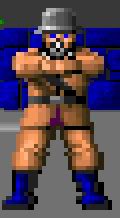
Guards - The most basic enemy, they have pistols and shoot rather slowly, pausing before doing so. Still, when up close they can shoot a huge chunk of your life away. They are pretty weak and can be taken down in as little as one shot.

Speech: Sees you - Achtung! (Attention!/Warning!)

Dies - (Series of screams)


Schutzstaffel - Also called the S.S., these large, armored soldiers carry machine guns and prove quite dangerous in groups or even on their own. They take many shots before falling, and drop their machine gun for you when they do.


Speech: Sees you - Schutzstaffel!

Dies - Mein Leben! (My life!)


Officers: Officers are very quick both on their feet and with their trigger finger. They are especially dangerous when hiding behind corners as you often have no time to react before getting shot. Shoot them without hesitation, as they only need a fraction OF a fraction of a second to fire.

Speech: Sees you - Spion! (Spy!)

Dies - Nein, so was! (Well, I never!)


 Mutants: Undead soldiers with guns surgically attached to their chests and blades (for show) in their hands. They are arguably the deadliest enemy in the game, as they can somewhat rapid fire and are totally silent as far as when they "activate." When you know they are around, it's important not to take corners too quickly as they could be waiting for you and you won't know it until, frankly, you're dead.

Speech: Sees you - (Silence)

Dies- Aagghhrrr...


Dogs: Seeming to be German Shepherds, they are quick, and run up to you to bite you right in the face. Despite this, it is quite harsh to have to kill them but a necessity. They are the weakest enemy in the game, and can be killed with one hit from anything.

Speech: Sees you - Bark!
Dies: (Whimper)


Bosses: Once you've made it to the ninth floor or level of an episode, you will battle a Boss character. Boss characters are always very large individuals compared to normal enemies and carry vicious firepower, able to put you down in a single second. They can sustain nearly all of your ammo before finally falling. Once they do, either the episode will end, or you will be given a key to find the end of the level.


Weapons: Of course, you'll need firepower to get the job done. Wolfenstein does not offer the amount of weaponry that we're used to these days and at first it can, admittedly, be a little disappointing. But to be fair, this was before First Person Shooter was an established genre. In time, you should learn to appreciate the arsenal that you are given. Here is a list of the weapons you can find and use in Wolfenstein 3D.


Knife - This is there for you should you run out of ammo or possibly just have a death wish. You have to go right up to an enemy to use it so it's not really ideal for any situation. But if it's all you've got then it's all you've got. Repeatedly tap the attack button to keep stabbing, and hope for the best.

Pistol - You start off with this as well as eight bullets. This is not meant to get you through the entire mission, what with its slow rate of fire and what not so try to find a better weapon as soon as possible.

Machine Gun - These can be found laying around a level or can be taken from a killed S.S. They allow you to just hold down the attack button for rapid fire. It's still not the best weapon but compared to the pistol it makes a galaxy of difference.

Chaingun - Large and Loud, this weapon is the strongest in the game, often hidden in secret areas. It shoots a minimum of two bullets at a time (unless shooting your last), and quickly takes care of any normal enemy, and is certainly ideal for boss battles (seeing as how many bosses carry this same weapon, and often in pairs.) Needless to say it eats up ammo pretty quickly so don't get too "happy" with it unless you have to.

Once you've gotten a handle on all the enemy types and building up your arsenal, you may think you're well on the road to mastering the game, but you'd be wrong. You'll start to really hate your life as a one-man attack team for the allies in the several Wolfenstein 3D levels that are designed, at least in part, like a labyrinth. Beyond every corner could be another hostile or even worse, you could be in the maze with an unknown amount of active enemies that may either ambush you from the front or sneak up on you from behind. Without patience you will not make it far. Many players with over-active testosterone will think that all problems can be solved by non-stop chaingun fire. But with so little ammo that can be held at once, they will find themselves only with a knife and seconds later, dead. Just because it's an FPS does not mean you don't have to be strategic.


Items: Along with firepower, you will need ammo for that firepower, as well as keys to locked doors, health, and treasure if score means that much to you.

Ammo Clip - These are how you renew your ammo supply. How you get them dictates how much one holds. If taken from an enemy they hold 4 bullets. If found new, 8.  You can only hold 99 bullets at one time which is rather annoying since you'd think with the rapid-fire guns you carry they could have at least given you a 199 bullet capacity, but you'll just have to deal.

Keys - Some levels hide a Gold Key, a Silver Key, or both. While keys and locked doors come in two different colors, they are in no way color coded, and you don't know which key opens which door until you try.

Chicken - A plate of chicken here and there is just what you need to keep going. They are worth 10 percent health.

Medkit - A slightly more legitimate source of health and will replenish it by 25 percent.

Dog Food - Usually located, you guessed it, where you find dogs. You can munch on that and gain 4 percent health back.


Blood and Bones - Drastic times call for drastic measures. If your health drops to 10 percent or lower, B.J. will drink the blood and chew on the bones of the deceased just to survive. It will replenish 1 percent of your health.

Treasure - There only for points, these come in various forms such as chests or chalices. You are rated after each level on how much out of 100 percent you've collected.


Extra Life - Usually found in a secret area, these award you an extra life, but more importantly, replenish all of your health and give you a cool addition of 25 bullets.


Item-wise, what you need isn't generally covered in the normal part of the levels and often you will find yourself seeking out the secret rooms.A big part of Wolfenstein is would be the many secret rooms that it holds. Secret rooms are discovered by pushing on certain walls. If you push on the right one, you will hear a "crunching" noise and the wall will audibly slide backwards, usually revealing a secret room. Secret rooms are often filled with weapons, ammo, health, treasure, or even more.Still, don't be surprised if the inside is disappointing. Sometimes secrets are entirely pointless.


Starting the game from any episode will at first make it quite difficult to get on your feet. You have just a pistol and a very small amount of ammo to get started with. How you start pretty much sets the tone for how the rest is going to go, and if you start off poorly, you may consider just retrying it until you do better. Assuming you're playing it chronologically, the first few levels of episode one have a very introductory feel. You just cruise around shooting some weak, helmeted Nazi guards while trying to get a feel for the game. So far, you don't need keys or all that much firepower. But soon enough, around the time the S.S. start to appear in large groups, you need to get better weapons and a better sense of survival. The game starts to get more challenging and aggravating when you start to encounter locked doors. Keys are often hidden in the worst places. Most notably, more than one level puts a key in a large room with a "patsy" guard in there to kill. Of course, doing this will alert about a dozen other enemies to your presence, just outside the large room. It becomes a bloody fight to the death, all for that one little key. Situations like this explain a lot of what you're in for during your play through of Wolfenstein 3D.


-Conclusion-

Wolfenstein 3D is an extremely important piece of work in the history of video games. It popularized First-Person Shooters in ways that would eventually lead to other greats such as Id's own DOOM or 3D Realms' Duke Nukem. Playing it is a very special feeling if you are a person that can appreciate this. With its many levels, hundreds of secrets, and prestigious difficulty, this classic shows that even almost twenty years later it can still entertain if you're lucky enough to have the means to play it. We are very excited to be able to review it and would certainly recommend that you find a way to try out this truly great game.

~Richard M.


*Music from the video game music preservation foundation.


Don't forget to stop by our shop for retro gaming collectibles:

LinkWithin

Related Posts with Thumbnails