Search This Blog

Showing posts with label retro game review. Show all posts

Friday, September 5, 2014

Not So Retro Review: Contra 4 Nintendo DS

When a gaming company attempts to put out a new version of a classic, beloved series, sometimes you just have to accept that it's not going to have that same flair your old favorites did. Sometimes you have to remember that the tried and true formula that made the original titles the masterpieces they were are going to be replaced by new and questionable features in an attempt to add freshness to an antiquated series. Sometimes you just have to accept that it's not going to be the same.

Luckily, in the case of Contra 4, that entire opening paragraph is entirely irrelevant.

If you want to run and gun, if you want to shoot up a base pseudo-3D style, if you want to search desperately for the spread shot while navigating the narrow platforms of the jungle, if you want to be irritatingly be hit by falling rocks on the way to an Alien Fortress on top of a waterfall, if you want to spend an RPG amount of time trying to survive 9 merciless stages with the brutal, console-throwingly difficult 2D gameplay that defined the late 80's and early 90's portion of your childhood, then you probably want Contra 4.

Get Psyched! Oh wait, wrong game.


Graphics:
 Graphically the game is an example of how instead of putting all of our energy into 3D rendering, we should also appreciate just how much we can do with 2D graphics in the modern era. This is a gorgeous game with very nice background visuals with some 3D effects added in nicely. The player sprites are a bit pixelated but animate very smoothly. The game doesn't suffer from intense flickering like the games of old do, which is nice because with all of the on-screen activity it's going to be hard enough to keep track of things. Artistically the game looks a lot like Contra III, which isn't surprising given how most fans loved that one the most. Many of the enemies retain their original look and the player sprites are very similar to their classic counterparts.

Alien breeding programs have eliminated the "ball arms" gene

Controls:
The controls are as responsive as they need to be and simple to get the hang off for the most part. The direction pad on the DS may give you some problems, especially when trying to shoot diagonally which may prove frustrating while you're new to the game. It's a little harder to really mash the shoot button on the DS due to the small size of the buttons and the fact that it causes the whole console to shake. By holding the R button, you can at least stand safely in place while you fire in any direction, which also allows you to fire directly downward without having to jump. If you've only played Contra and Super C with lacked this feature, that's an incredible button right there. The simplicity of Contra's controls will lead to the same problems they did in the old days, such as accidentally dropping down from a ledge when you try to jump too soon after shooting at an enemy below you. The new ability to climb ropes affords itself many opportunities at accidental and deadly dismounts when you're trying to do too much at once and while none of these issues are necessarily new to this game, they are a perennial source of frustration.

Sounds:
The sound effects are crisp although some are rather quiet, so you'll have to strain a little to enjoy that classic 'p-choom' sound unless you've got headphones. The classic ricochet noise which denoted a successful shot on an enemy returns for added nostalgia, though most of the sounds in the game will be more updated. The game's music features some new tracks and several remixes of the ones you remember. If you're playing on Hard then you're rewarded with an enhanced version of the original Jungle track. Arguably the greatest 8 bit music ever, the Base Boss music from the first Contra returns in two of the three base-style levels as you're fighting the final enemy there, offering a more percussive and instrumental version, coming off as more dramatic (though not necessarily better) than the original version.


Gameplay:

 Mad Dog has chosen the passive-aggressive approach
After years of questionable titles and a few decent but very different ones, Konami's Contra 4 on the Nintendo DS is clearly meant as fan service to the long time fans of the run n' gun series, from the game itself, to the bonus unlockables, and even the booklet is made lovingly with long-time fans in mind. The game takes its overall design from the first three Contra games, featuring levels, weapons, music, and bosses borrowed or inspired from Contra, Super Contra, and Contra III: The Alien Wars. Contra 4 takes place soon after the events of Contra III, serving as a direct sequel to that game and ignoring all the rest that came in between (which is good because those storylines were crazy and the characters were wearing shirts). Midst the familiar features, the game brings fresh new ones to ensure that it isn't just a phoned-in reboot. While a few of the levels are clearly inspired by the look of some of the classics, they are set up in brand new, challenging ways while retaining the original feel. This includes the pseudo-3D shooting galley-like base levels which retain the "shoot the red things" goal but with beefed up enemies and hazards. One of the biggest new factors in the game is the simultaneous use of both the upper and lower screen, adding a huge new challenge to a game that was not exactly short on them to begin with. The insane difficulty remains intact, so only elite players will see the end. All in all, the easiest way to describe the game is...it's a Contra game, with all of the good and bad that comes with that status.

 With the addition of only a few new tricks, the core gameplay is unaltered from what we've grown accustomed to, feeling the most like Contra III, which might seem expected, given the numbering, but let's remember that they're 15 years apart. Before starting the game you can select which character you want to use. So if you're like me and sad that you have to be player two to enjoy the benefits of red pants, now you can choose Lance (the red pants guy) instead of that stuck up Blue Pants Bill right out of the starting block. Two other characters, Mad Dog and Scorpion, are also immediately selectable, and if you're familiar with the regional differences between the original Contra games, you know why that's such a delightful addition. All of these initial characters are just color palette swaps of each other, but if you ever felt that Bill Rizer would be better represented as a black guy with a golden rifle then this game's for you.

This seems very familiar

After your support chopper drops you into the jungle, careful not to insult your manhood with a helpful missile or two aimed at your enemies, you'll find yourself in the same position in which you found yourself way back in the original Contra, with a big gun that shoots one small, pathetic round at a time. Even the sound effect is exactly the same as it was in the NES days. Your mission on every level is simple to say but nearly impossible to do, run to the end of the level while shooting everything in sight before it gets you. If you take one shot from anything, you lose a life.

    Enemies come in all forms, from the backpack carrying cannon-fodder guys who used to irritate us on the waterfall (and still do) to durable gun turrets which take many shots to destroy. There's an increased premium on mid-bosses in Contra 4 which help give each level some added depth and challenge on the way to the eventual main boss. Mid bosses are among the most interesting enemies and may take the form of a large alien, a powerful tank, a giant robot, and more. It's not uncommon to encounter a mid boss that's actually more difficult than the level's final boss.

Spreadshot is love

   To help you navigate all of these hazards, your character can climb certain walls, hang on bars and certain ceilings, and can now climb ropes or rope-shaped alien entrails, which does unfortunately open the door to the 2D platformer rope nightmares we all remember, and more than once you'll be lamenting the loss of a life while asking, "why didn't we grab that rope, Bill?" New to the series, you are also given a grapple hook which is used to latch onto hangable objects above you. The grapple hook with shoot all the way to the heights of the level but you're very vulnerable to attack while it's pulling you up there. In an effort to make use out of this new tactic, weapon pods can often be found over deadly chasms, forcing you to shoot them open, jump down just far enough to collect the item before it's lost, and then grapple back to safety before it's too late, which looks pretty darn cool when you pull it off, but is rarely worth the trouble. Perhaps you might feel the use of the grapple hook adds a needless new learning curve in a series that's already too damn hard, but you'd better get used to it, as several key parts of the game require it. Sticking to running and gunning and some light climbing would be ideal but the grapple hook just may save your life one day. Or possibly cost you one.
Grappling can also leave you temporarily headless

Better weapons and powerups are shot out of pods imbedded into the background, or from flying pods which look very similar to those found in Contra III. If you're hoping for some new toys to play with here then you'll be somewhat disappointed as all of the weapons within have been featured in previous titles. However, all of the weapons can be upgraded by picking them up twice, so their functionality will improve in ways you may not expect. In some cases, the upgraded weapon is If you're playing on Easy, they all start off fully upgraded. Being able to upgrade the weapons puts an increased premium on collecting them as well as making it more tragic when you're killed, and your weapon is lost. Like in Contra III, you're allowed to carry two different weapons which is awfully helpful, since you only lose the one who had equipped when you die. Unlike Contra III you can't fire both weapons at once although there was really no tactically sound reason to do so in the first place. You can also discard your weapon, tossing it to the ground. This is useful if you're playing with a friend and are generous enough to share the wealth. It can also be helpful if you know you're about to get hit by something that don't want to lose the weapon permanently. Although if you're new to the controls you'll find yourself accidentally throwing away your weapons at very inopportune times.

Crap.

The levels play similarly to how they'd play in Contra III, with most of them being a side-scrolling format allowing you to climb rails, walls, and ropes in order to get to higher plains. Many portions of the game give you the option to take the high or low path, so you can run along the roof tops of the crumbling city or try your luck on the mean streets below. This would be especially helpful on multiplayer so you can finally get your buddy the hell out of your way, relegating him to whatever path you don't take. One of the levels takes place over the ocean on a futuristic jet ski, sort of like an aquatic version of the hover bike level in Contra III. And to the delight of fans of the original Contra, there are three shooting-gallery levels reminiscent of the bases from the first game. These levels are even harder than they were in 1987 with more tricks and traps awaiting you, but with the faster pacing and new features, may be even more fun than the bases you remember. Or maybe just more infuriating.


Aside from the regular campaign, you can also unlock Challenge Mode, which sticks you in 40 different scenarios, demanding that you complete tasks ranging from completing a section of a level without being able to shoot, having to retain extreme accuracy, taking on a boss without sustaining a single hit, and more. Some of these are unimaginably annoying, and not in the good Contra way, but just in an unfair, irritating way, which I assure you is actually different. For example, when playing some of the Pacifism modes, where you can't shoot, you're basically at the mercy of what the game throws at you. Sure, it might give you 3 paths to take but say enemies are on all three paths, preventing you from jumping, dropping, or standing your ground. What do you do? Nothing, you're screwed. Most of the challenges are fair in some very hidden way, but some of them will have you contemplating just how important a DS really is while you're looking for a hammer. As you complete these tasks you'll be rewarded with various unlockable bonuses which actually manage to justify the injustice you've just suffered. These bonuses...these bonuses are perhaps the greatest example of fan service the game has to offer. The booklet specifically says it offers no spoilers on what these prizes are, and in honor of that they won't be mentioned here, but to give you a small idea, if Contra 4 itself were absent from the game and only the unlockables remained, it would still be worth buying. Seriously.

So the gameplay in general is pretty great, classic Contra at its finest with a few new abilities. But alas, we must also cover the grim matter of the difficulty. First the good news: It's not as hard as Contra III. But then, few things in life are. However, the difficulty of Contra 4 is still insane and will scare off the modern gamer used to endless life bars and unlimited continues. It's much harder than Contra and Super Contra and requires extremely skillful maneuvering and heroic patience. The game can be set to 'easy' but the last two levels won't be available, and it's not as if "Easy" isactually all that easy anyway. If you're feeling extra masochistic, you can put the game on hard, where enemy bullets are almost too fast to see and bosses boast a carpal tunnel inducing number of hit points. As eluded to earlier, one of the hardest things about Contra 4 is that it takes place on both screens, making it very hard to see threats coming from the screen opposite of the one you currently occupy. You either have to look at what's coming or keep and eye on what's happening on your screen, either option increasing your mortality significantly. Plus, enemy fire briefly gets lost in the space between the two screens making it extra difficult to keep track of it. Honestly this is one of the more frustrating facets of the game, and whether it's intentionally meant to increase difficulty or just an unfortunate side effect of an attempt to take advantage of the DS platform, it does beg for an eventual adaptation to a single-screen platform if ever possible. Fortunately the overall game is great enough for this not to ruin it.

Bill must eliminate all the Aliens before 20th Century Fox sues him.

Conclusion:

Contra 4 is a prime example of what can be accomplished two decades into a long-running series when its made with the fans in mind and not just the money. Contra 4 isn't made to appeal to a new generation of gamers. It doesn't even try. This game is solely for those who loved Contra, Super C, and Contra III, loved the punishment and tragedy they dished out, and wanted more. Fifteen years after the last classic Contra, this game proves it can hang with its iconic predecessors and is easily the best Contra to come out in the 2000's. It doesn't try to be new or different, it just tries to be good. There is no fathomable reason that any classic Contra fan wouldn't become an immediate fan of this classic Run and Gun experience.

~Richard

* A few of these screenshots came from IGN.

Don't forget to stop by our shop:

Sunday, January 19, 2014

Retro Review: Metal Gear Solid Gameboy/Metal Gear Ghost Babel

  -Introduction-

Metal Gear Solid on the original Playstation remains one of the most popular titles of all time, giving birth to the Metal Gear Solid series of games which remain legendary for their excellent gameplay, captivating storylines and impeccable voice acting. People know all of this already, but what some may not know is that Konami also produced a Metal Gear game on Nintendo's Gameboy Color, nearly two years after the release of Solid. In Japan it was known as Metal Gear: Ghost Babel, but renamed to Metal Gear Solid in North America, presumably to take advantage of the success of its Playstation predecessor.

    Fans who may have seen the GBC version of Metal Gear Solid laying beneath the glass of the display case in video game shops may have dismissed it as a crappy, 8-bit version of a game they love for the small screen. Those people, however, would be dramatically incorrect in their assessment. Featuring a brand-new story, surprisingly solid (no pun intended) graphics, and effective, familiar gameplay, Metal Gear Solid on the Gameboy color stands as one of the most impressive Gameboy titles of all time. There are many modes of play in this game, but for this review, we'll focus on the main game as well as the VR Missions.

    This non-canon story follows Solid Snake seven years after his mission at Outer Heaven. Recruited by Colonel Cambell to defuse another potential world disaster, Snake finds himself back in Galuade to confront the demons of the past as well as the demons of today. This time the terrorist struggle is spearheaded by a renegade group of elite soldiers known collectively as Black Chamber, each member boasting a dangerous special ability. Heading this group is Black Art Viper, a vindictive near-insane warrior specializing in tricks and traps.Snake must stop the terrorists from utilizing a new model of Metal Gear to launch a nuclear weapon.


  -Presentation-

An inauspicious start to the mission.
Graphics:   Graphically, Metal Gear Solid on the Gameboy Color is artistically average during regular gameplay but excels at details and movement. Solid Snake is drawn from 8 different angles, meaning that he will turn to face any direction in which he is running. The same is true for the enemy characters. Metal Gear's use of 8 angles is a subtle detail that goes a long way in improving overall presentation, although the character sprites are too small to show any facial features during the normal gameplay. Environments are rendered colorfully and clearly, and are successful in basically depicting that which they are meant to be, although the overall design of various indoor stages can tend to be a bit homogenous to each other. The game features several cutscenes in between chapters which feature the characters rendered in greater detail amidst generally generic backgrounds. These cutscenes are static much of the time with occasional, simple animations such as a turning head, shaking fist, or the graceful fluttering of Snake's trademark bandana. The Codec screen is designed very similarly to the one in Metal Gear Solid on the Playstation, even with some fun little screen noise effects and static on the images of the speaking characters. On this screen, character's faces are drawn in better detail, but aside from the screen noise effects they remain completely unanimated, even during exclamatory outbursts.


  Sound:  The game's sound effects are about par for the Gameboy Color era, but there are plenty of them, be they entirely different or recycled variants to at least retain some variety. Expect various forms of beeps, buzzes, and thuds. There are multiple explosion sound effects which sound pretty good for what they're working with. Like most Gameboy Color games there is no spoken dialogue, only captions.

And are you related to Sephiroth?
  Music: The music ranges from somewhat boring to excellent. Some of the music is original to the game while other tracks are based on their Playstation counterparts or even harken back to the original Metal Gear game of the 80's. Although none of the music is repetitive to the point of torture, some tracks can start to get old if you're stuck in any one area for enough time, especially since the music for many of the indoor areas is the same. The music really shines during boss encounters, boasting the kind of epic 8-bit boss music Konami is known for. While the boss music in the Playstation version tries for a more "epic" vibe, the music within this game is more of a heavy-metal, action-oriented sound to get the blood pumping for ass kicking. The best piece of music in the game is easily the music which plays during the final battle, returning to the series' epic-style roots and successfully conveying a sense of finality to the battle at hand.

    -Gameplay-
  
Main Game

    The gameplay of Metal Gear Solid on the GBC is the most impressive part of the game. Controls are responsive and movement is fluid and easy to handle. Despite the simplified design, the game incorporates many of the themes seen in the Playstation release. Stealth is a premium in this game, and the player is able to utilize many techniques to achieve it, including wall-hugging, tapping a wall to lure an enemy, crawling on the ground or into a crawl space, as well as in tall grass or under water to remain unseen. The player can also travel through the air ducts either to remain unseen or to gain access to an otherwise unreachable area. Controlling Snake is easy to learn with few detracting quirks.

Good thing snake isn't claustrophobic.
    As with the Metal Gear Solid we know and love, the player will try to find their way through various areas while picking up weapons, ammo, health-restoring rations and keycards for locked doors. Familiar facets of your mission also include having to blast your way through thin walls with plastic explosives, using remote controlled missiles to reach targets that Snake himself cannot, and utilizing night vision and thermal goggles see in the dark and/or detect infrared lasers. Including these themes into the game help to keep the gameplay from becoming a simple run-around in a series of glorified labyrinths.

 The in-game arsenal offered to the player is a bit smaller, including a Pistol, Assault rifle, C4 explosives, Landmines, Grenades, Chaff Grenades, Stun Grenades, and Nikita Missiles. It's enough to keep things more interesting although as with most Metal Gear games, most of your time is reasonably spent with just the pistol or the assault rifle in the case of large fights. Items such as body armor, a gas mask, and a landmine detector make their return as well. The "Fogger" device, which emits smoke to allow the player to see invisible laser beams, is likely the result of censoring, as the device looks suspiciously like Snake's trademark cigarettes and is already in the player's possession at the start of the game. The inclusion of these gadgets help bring the game further into familiar territory and add to its complexity.

  And of course, when out of other options, the player can slip into the trusty box.

I wish I were that relaxed.
  The enemies of the game aren't particularly smart but certainly aren't ineffectual. While knocking them out doesn't seem to convince them that something is amiss, they're fairly accurate with their gunfire and annoyingly effective with their gun-whipping. Enemy soldiers can become suspicious if the player taps on the wall or walks over some kind of noise-making floor, and will become alerted at the sound of any weapons discharging, save for the suppressed pistol. Once alerted to the player's presence, enemies quickly spawn from seemingly nowhere to surround Snake. Reasonably aware players will be able to evade or eliminate the enemies without much challenge but doing so while staying in the same area can be frustratingly difficult with the respawning. In many cases the player can take advantage of a little quirk by changing screens from one area to other in quick succession in order to eat away at the ALERT counter, as it takes a little while for enemies to spawn in the new area if one isn't already assigned there. It can also be annoyingly hard to regain the upper hand on an enemy after being knocked to the ground from a gun-whip, as Snake often won't be able rise and put enough distance between himself and an enemy to evade another knock-down. Snake's inability to quickly turn and attack an enemy in one swift motion can also lead to frustration. The standard battle system is simplistic but it's enough to motivate the player to remain unseen.

A surveillance camera!?
    Other enemies/obstacles remain such as surveillance cameras, gun-cameras, dogs, landmines, and trap-door floors in order to change up where your challenge comes from. Cameras can be temporarily snuffed out with a chaff grenade while mines can be detected with, yes, a mine detector.

There's a reason Claude always lets Jacques go first
 The game's replay value is increased with the varying difficulty levels. Your enemies' attack power and hit points varies with the chosen difficulty level, along with whether or not they can be killed by hand. On Hard or higher, only weapons will kill an enemy soldier which will greatly change your overall strategy experience.

It's on like Donkey Kong other fine Konami® games.
The boss encounters are adequate in providing a climax to each chapter of the game, even if they're not the kind of profound confrontations we've come to eagerly await in the Playstation release. The bosses are generally pretty simple to take down although on harder difficulty levels some of them are extremely frustrating, especially Marionette Owl whom you must fight in the dark and punishes you for striking the wrong target. Appropriately, the most challenging boss fight in the game tends to be showdown between Snake and Metal Gear itself, which is something that pretty much none of the console releases can say. The battle with the iron giant may not feel as epic as the fight in Metal Gear Solid on the Playstation, but it is enough to provide a suitable climax for the game to build to. And for what's it's worth, the design on Metal Gear is pretty darn good.

    The implementation of the Radar is passable but not stellar. It helps give a general idea of where nearby enemies are but it's not great for much else. Unlike Metal Gear Solid on the Playstation, there is no differentiation between dangerous enemies or objects. Soldiers, cameras, dogs, incoming missiles and landmines all appear as a redish dot. It's especially annoying when in a mine field that also happens to contain enemies (although that tends to happen more often in VR Training). There is also no more representation of an enemy's field of vision, so you'll be unable to see which way an enemy is face, and how close is too close.

In spite of the name this floor isn't entirely made of plastic explosives.
    Interestingly and unlike other Metal Gear games, while the overall gameplay remains similar to what we classically know as Metal Gear, the game is laid out in stages/levels, rating your performance after you complete each one (don't feel bad if your rating is almost always "terrible" it seems unavoidable the first time through...and for much of the subsequent play-throughs). It's easy to forget, however, that this format is in place, as there is usually decent time in between "chapters" while you're trying to figure out just exactly what to do to move on. The good thing about the stage format is that since you are unfortunately unable to save more than a single game at a time, you can at least go back to any stage you've cleared if you want to play that chapter over again. However, you will only be equipped with the items that are absolutely necessary for completion, so even if you had, say, body armor, an assault rifle, and a pistol suppressor during your initial play-through, those items will all be absent in Stage Select mode.

    Dying will either send you back to the beginning of the level you're in, or to the last significant item you picked up which, depending on where it was, could either be very convenient or extremely irritating. This is especially true for boss fights as dying there can mean a decent schlep ahead of you in order to get back to the fight. Certain items picked up between collecting the "checkpoint" item and whenever you died will have to be collected again, making death exceedingly annoying and paramount to avoid.

    As progress through the game is made, you'll see that the game's story is not nearly as riveting as the console releases, but it's enough to pique your interest as to what is going to happen next. Snake's inner struggle with his own haunted past is as present as it ever was, and annoyingly, so is his subtle fascination with a female, fellow soldier. As the plot progresses you'll see the government conspiracies that made the series famous as well as the usual, (though not as jarring) twists, unexpected pathos for your fallen enemies, and even a moment of tragedy (well it tries to be but the character at focus is a little too irritating for you to care that much). And of course, the whole stopping-the-nuke thing.

Snake considers himself more of a Bishop.
For the most part, the story is sound all the way through although it does fall short in hyping the eventual confrontation with the 'General' whom pilots Metal Gear in the game's most climactic battle. While the fight itself is good, Snake has had literally zero contact with the character up until this point, as he's only seen sporadically throughout the game, broadcasting threatening messages to the US government.

 VR Training

The evil polygons will pay for what they've done.
    Although the main game itself would be more than enough to be a called a complete handheld title, the game generously offers a plethora of VR Training missions for the player to train on or just have something fun to do after completing the main part of the game. The VR missions are essentially a series of mini-missions requiring the player to eliminate a certain number of targets, reach the goal undetected, or complete one of those tasks in a limited amount of time. Interestingly, there are more VR missions featured in this gameboy release than there are in the Playstation version of Metal Gear Solid. The VR missions include Sneaking Mode, Weapons mode, and an Advanced mode allowing the player to dispatch live targets, offering a total 75 unique stages and 180 challenges to complete, an amazing amount of content considering that some Gameboy Games of the time boast less content than what is featured in the VR missions alone.

Trouble brewing
    As expected, the VR missions take place in a virtual-reality world, basically an 8-bit version of the environment featured in the Playstation version. Some of the levels are even essentially identical to their Playstation counterparts. The mini-missions within allow for unique combat opportunities that don't necessarily appear in the main game, giving the player more opportunities to play with their favorite weapons. VR mode isn't necessarily the most thrilling part of the game, but to have so much bonus content in addition to a full game is a big plus. The incentive to complete the mode comes in the form of an unlockable Sound Test (remember way back when that was considered a reward in a game?).


  -Conclusion- 

 As one of the most complete gaming experiences to be licensed for the Gameboy Color, this fun alternative to Metal Gear Solid is indeed a must-have for any fan of the Metal Gear series or just for those who love quality handheld gaming. With a mountain of pros and very little cons, the game is sure to be enjoyable from start to finish, and one that will have players coming back for more soon after completion. Even among today's highly advanced handheld titles, Metal Gear Solid is certain to be among your favorites once you've make the highly recommended decision to make it a part of your handheld collection. Overall a 4.5 out 5 cephalapoint rating.


~Richard

Don't forget to stop by our shop:
 

Friday, April 13, 2012

In Honor of Friday the Thirteenth: Friday the 13th NES Game Review

This was originally posted back in 2009, but we felt it should be revisited and revitalized a bit in honor this auspicious date.

Enjoy


INTRODUCTION

Nearly thirty years ago, Paramount produced a movie that would forever staple the "Summer Camp Horror" cliche into our hearts. Only a very special film company can turn a story about a vengeance-seeking homicidal mother of a dead mentally retarded boy into a never-ending series about an undead, invincible, hockey-masked super-human killing machine. It takes a very, VERY special video-game development company to turn this killing-machine into an 8-bit, blue-masked-purple-jogging-suit-wearing juggernaut squaring off against six faceless "counselors", while at the same time turning this into a zombie invasion. Can such a video game really exist? Why yes, it can. What can you do to be a part of the magic? Well, first you can read this ironically elaborate review.


OVERVIEW


Sarcasm aside, let's get this straight...it's an LJN game, it's terrible. That aside, it is actually one of LJN's better put-together titles, and one of the first-ever survival horror games. The game actually manages to "scare" you, when the masked maniac suddenly appears on screen with little to no warning, in many instances. And let's not forget the game's infamous difficulty.


Oh No! It's Jason and he's got a purple jogging suit!
Once the game is started, it goes right to a well-rendered intro sequence, which is an animated throwback to the famous cover design of the Part IV movie case, where a knife flies in from God-knows-where and sticks into the eyehole of Jason's Hockey Mask. Then the screen flashes violently. It's easily the most graphically impressive part of the game. While you sit there, noting how they must have blown their entire budget for the game on that opening sequence, the title screen will appear. You push start, and after it tells you to light the fire places, you select your first character.

Your goal in this game is to destroy Jason before getting all six of the counselors killed off. Likewise with the fifteen children, whom were looking forward to an enriching summer of hiking, rowing, singing, not getting slaughtered, and fishing. You kill Jason by using six different weapons of differing strengths and uses (and by uses, I just mean strength.) When you hear the alarm, indicating to you that Jason is either attacking a fellow counselor in their cabin, or the campers, you race to the cabin, and have one of many, many battles with the Demon of Crystal Lake, until you finally put him down once and for all (or, at least until the next sequel).

Graphically the game is actually pretty well rendered. The backgrounds even change, in the distance based on your location, IE: changing to trees when you're getting near the woods, rock when you're near the cave, and water when you're approaching the lake. They are rather simplistic, but get the job done as far as clarity of the situation, except for Jason of course...nobody's ever going to understand that.

Sound wise the effects are pretty crisp, although nothing resembles anything close to a realistic sound. All of the sound effects are your standard, classic beepy-boopy electronic sound of some sort .Though notably missing is Jason's trademark sound (if you're familiar with the movies you know what I'm talking about.) The music is like most any other NES game, it is obnoxiously repetitive yet strangely intoxicating. The music that plays while inside of a cabin is especially notable, for its distinct sound and ambiance.


GAMEPLAY


-Characters-

I could get extra analytical about this and scout each and every character's strengths and weakness. Instead, I could just put it like this - use Mark. Crissy and Laura are okay too, but Mark is who's going to do this for you. Avoid doing anything with Paul, Debbie, or George. Eventually it will become a necessity to use these three, but until that time comes, put them away in the closet, and take care of Mark and his girls. Though for those of you who WANT something more analytical, read on.

If you going to lay out a kids camp in such an unsafe fashion you kind of deserve a masked maniac


Mark - Moves fast, rows fast, jumps high, he's your guy.Take care of him so that you may make him last for the entirety of the game. Make sure he gets all the potions he wants and give him the Sweater (both of those things will be discussed, below).

Crissy - Also moves fast on land, jumps high, she's just about the female equivalent to Mark and you should also take care of her, as well.

Laura - She moves quickly, but sucks at jumping. She's still a better choice than George, Debbie, and Paul but only because of her speed.

George - A useless cretin, he excels at absolutely nothing. Also, he's also the least attractive one, so it's a pretty standard notion than you want nothing to do with him.

Debbie - She's pretty much just female George, although when he throws a weapon, she really whips that thing. Still, with a name that even SOUNDS slow, Debbie is definitely on the reject list.

Paul - Paul's only better than Debbie and George because he's black. But even so, how black is he REALLY? His name is Paul, for crying out loud and he can't run OR jump. But you have to cut him some slack - he's the one most likely to die in this situation.

-Playing the Game-

You wander Camp Crystal Lake, wondering how a place that so frequently experiences mass murders can STILL be a problem, looking out for goodies and Jason. To keep you busy while Jason's deciding who to kill, you battle yellow and blue zombies, who even walk with the outreaching arms. They are the most annoying part of the game, however, killing them will give you the invaluable lighter (which the game refers to as a "torch" ...perhaps LJN are a bunch of bloody wankers from England?) and killing enough of them may even grant you a special weapon.

Just havin' a friendly chat

Every now and again, Jason himself will appear right on the screen without warning. He has a bit of tell though, generally indicated by whatever zombies that are on screen walking off the screen and by the screen halting its scroll, as you move. When Jason appears he will throw spinning axes which are rather hard to dodge. Hit him enough times with your weapon, and he will run away. The game is slightly realistic in the sense that if you follow him you will likely end up fighting with him again in a moment. Also, if Jason leaves and suddenly the alarm sounds, it will probably be very close to where you two just battled.

Once the alarm sounds, you look to the status bar atop the screen, and see which indicator is flashing. If it is the Counselor Indicator (The one next to the potentially changing number of unhappy-looking faces) you then press start to see which cabin it is that Jason is occupying (it will be green and flashing). A timer will appear next to the flashing indicator, giving you sixty seconds to reach the cabin. It is pertinent that you get over there as fast as you can. The longer you take, the more Health the counselor inside loses and you may need to use this counselor at some point. If you're dawdling, indifferent, or more likely - lost in the woods, and time expires, Jason will slay the counselor inside, effectively costing you one life, and the use of that character. GOD HELP YOU if it's Mark. If the Children Indicator is flashing, then you've got slightly more of a chore to deal with, as the only way to reach them is to row your boat across the lake to their cabins, all the while getting attacked by zombies, birds, and  Jason himself,  who's attack you can do virtually nothing about other than wonder how it is that he's in the water attacking you while simultaneously  killing the campers. The more time you spend dawdling on the way to the campers the fewer of them there will be. Once Jason has wiped out a cabin full of children he will move on to the next cabin when he strikes again. If all your children are wiped out it's game over so as much as you might like to, you can't ignore them.

Thank goodness the quintuplets are safe

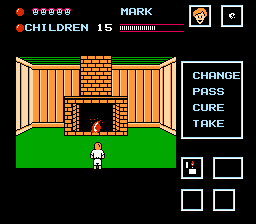
Once you've entered a cabin, the screen switches to a pseudo "3D" screen, with very limited movement and excruciatingly slow progression. If there is another counselor in the cabin, you can switch weapons with them by pressing select and choosing the "PASS" option. Though leaving them with a weapon, no matter how nice it is, doesn't seem to help them fend of Jason's wrath without your help. You can also switch places with each other with Select-CHANGE. If you having a potion, cure them with Select-CURE. If you find a weapon or note on the cabin floor, take it with Select-TAKE. If you're in an empty cabin and press start you can choose a new character and you'll start from their cabin, if you do this in an occupied cabin, the cabin's original counselor will move to an unoccupied cabin.

Occasionally you will enter a cabin that Jason is randomly occupying, even if there's no alarm. While in a cabin, you can tell if Jason is there with you because his life bar appears at the bottom of a screen. If you are attacked by Jason in a cabin, you square off with the purple-suited psycho while he attacks with either his fists, a machete, or what looks like a hair brush, but is most-likely an axe. You throw the weapon you have at Jason with the B button. By pushing down and over in any direction on the D-pad, you can dodge Jason's attacks when he steps in front of you. Sometimes Jason will attack you twice in a row without moving, so stay on your pixelated toes. Once you've hit Jason enough times, like any other NES sprite he will flash and disappear and a message will display on the screen, reading "You win...for now." Ominous, no? Meanwhile, Jason will wander off to continue his murderous rampage.Jason's Health Bar depletes over the elapse of several different battles with him, so depleting it entirely can take quite a while.

Sometimes though, if Jason's Health Bar is low enough, he will fight you until it depletes entirely, something that really sucks if you only have one of the first two weapons. Jason may also try and fight to the death when he attacks you on the path, but here, you cannot see his Health Bar, so you just have to keep fighting until he flickers.

Once you've totally depleted Jason's Health Bar, you get a less-than-congratulatory message, and you will find yourself having to kill him again - only now everything's harder.

-Days-

The game spans three "days," each new day starting when you deplete Jason's health. Each day follows a cycle, starting off in daylight, turning to dusk and then night, the progression being completely dependent on how often you enter and leave a cabin.

Day One - Everything's standard, Jason's at normal speed, takes off normal health, zombies are at normal speed...it's normal.

Day Two - Zombies are faster, and Jason is stronger and every now and again takes a snort of crack and starts really flying, making his attacks nearly impossible to avoid, completely.

Day Three - Zombies are still fast and possibly more frequent,  and crows appear on all the roads. Making matters worse it that Jason has become a non-stop speed-demon making every encounter with him a real labored attempt.

-Areas-

Aside from the cabins, there are four different areas to scroll, each of them exhibiting their own special traits and enemies.

A lovely day by the shores of Crystal Lake
Road/Path - The normal screen of the game, you can use the map to navigate this and see which cabins are where,though  often the implied distance is far from accurate. If you happen upon a new, alternate path leading into the horizon, or one at your feet, you can press up or down to travel them, which may lead you to the perimeter of the cave or lake, into the woods, or into the cave or lake.

Whoever established this camp hates kids & counselors, why are there no trail markers?

Woods - Taking on Labyrinthine qualities, it's very easy to get lost in both wooded areas, traveling up and down paths that don't always lead to the same place twice. However, the Woods do hold secret cabins housing secret items and they also yield an abundance of potions. So occasionally venturing in can be very worthwhile.

Not sealing off this cave is a lawsuit waiting to happen
Cave - Dark and...scary? This area has bats and holes for you to fall down and die in. It's a bit hard to tell where some of the alternate paths are (the ones in the backgrounds are almost invisible their location hinted only by the crumbled rocks on the ground in front of them, among the other rocks), but once you collect the flashlight, it's much brighter and the paths are easy to see.

You can tell it's a water zombie because it's blue, wouldn't want to mix it up with the land variety

Lake - Here, you row to wherever you're going, the camper's cabins being the only non-pointless destination.  While boating you try to avoid zombies jumping out of the water, birds, and Jason. It takes a little while for your character to accelerate to max boat speed, and the maximum speed is dependent on the character you're using.

-Weapons-

All weapons are projectiles. Nice that picking up just one gives you and endless supply.

Stone - Your default weapon, it takes five hits of these useless things to take off a single pellet of Jason's life...Jason having thirty-two, randomly-numbered pellets in total. (I don't mean to mention crack again...but these ARE big, white rocks...)

Knife - You get this, along with many other items, by jumping in certain areas. You are guaranteed to have at least once instance where you accidentally lose a great weapon by picking up one of these by mistake. Four hits to a pellet, it's not a whole lot better than the Stone but it's still an improvement.

Machete - You can get this either by defeating Jason's mother in the Cave, finding it in a cabin in the Woods, or killing fifty zombies. Usually when you earn this via zombie-death, you're not ready for it, and either would have to downgrade your weapon to get it, or gain nothing, having already acquired a Machete. It's too bad to see it go to waste, as it kills zombies in one hit, and takes only three to take off a pellet of Jason's life.

Thank goodness a class in advanced knife throwing was offered at the camp before things went sideways
Axe - A strong weapon, but slower compared to the others. You throw these spinning, just like Jason does on the road. This can only be acquired by defeating Jason's mother under certain circumstances, or finding it in a secret cabin in the Woods. One hit for zombies, Two-per-Jason pellet.
Torch - The most useful weapon in the game, this one can even be used to hit Jason in the Lake, making those attacks just a bit more fair. This weapon drops to the ground when you throw it, burning for a second, and killing zombies that absent-mindedly run into it. It also takes a health pellet from Jason per hit. It is acquired by lighting certain fire places and then finding it in a cabin by the lake, or by getting it from Mrs. Voorhees. It may also be available in a secret cabin.
Pitch Fork - The hardest weapon in the game to acquire, it is only available by killing Jason's mother on Day Three. It's very fast, passes right-through zombies, killing them instantly and takes off one pellet per single hit on Jason.

-Items-

Items can only be collected by coming into contact with them while jumping. It sounds dumb, but it actually makes it a little easier to avoid collecting unwanted pick-ups. However, it frequently threatens to do the very opposite for you while you're jumping to avoid an enemy.

♫ ...am I only dreaming? Is this burning an eternal flame...♪
Lighter - Use this to light fireplaces in big cabins.
Potion - You can use these to regain a small amount of health or to heal your fellow counselors in need. If you're carrying one of these when your Health Bar depletes, it will automatically be used and saving you for the time being.
Key - These are used to unlock the doors of secret cabins and the door to Jason's mother's lair. One key can open everything without seemingly disintegrating in the lock,  unlike so many other games.
Flashlight - This is found when certain fireplaces are lit. It appears inside the cabin instantly after you finish the fireplace so don't leave the area or it's gone. You can use this to light up the cave and reveal hidden paths, though it's rather useless once you know what to look for.
Notes - Random notes are left for you in large and secret cabins. They may hint on to where you may find a special item, or they may just tell you to go into a random cabin or into the woods.

-Enemies-
Zombies - The standard enemy of the game, they basically give you something to do while Jason's inactive. Easy to deal with, but you get tired of it real soon.
Lake Zombies - These jump out of the water while you're rowing the canoe. Rather annoying, but weaker than normal zombies.
Birds - Maybe it's a crow? Either way, it appears after about 10 zombies come and go, takes only 1 hit to kill, but it's pretty annoying to deal with. Seen both on the road and over the lake.
Wolves - Appearing in both the Woods and the Cave, (colored baby blue while in the cave for some reason) they're very hard to deal with. They're fast, they jump, and they're very tough, sustaining a lot of damage before being eliminated. It's recommended that you just run away from them.
Bats - A weak enemy that appears only in the cave. Not a huge problem.
Jason - The Hockey-Masked killer we all know and love is done less-than justice, in his sky-blue mask, skin of the same color, and purple jogging-suit. However, his admittedly hilarious look is no reason to take him lightly. Very strong and very fast, as is right, if someone's gonna get ya, it's him.

This looks like it's gonna be pleasant, surely nothing bad will be behind that door.

Mrs. Voorhees - Jason's beheaded mother, she floats up from her candle-lit alter and basically headbutts you with the remains of her body. You can battle Mrs. Voorhees once on all three days, enjoying her shifting of color for each. Her location is obscured, but if you defeat her, you will be granted a special reward, depending on the day it is, and/or the weapon you are carrying:

Day One Prize - Machete. If you already have one, Axe. If you already have that, Torch. Already have that? Axe again.
Day Two Prize - Sweater. In the movie series, the sweater played a notable part in Part 2. It was blue then. Here, the Sweater is a neon pink and yellow...yeah. Upon getting it, your current character will sustain only half the damage he or she receives. You will also flash from your normal color to green, making you feel extra special.
Day Three - Pitchfork. As stated earlier, very strong, very nice. Beware, though...Mrs. Voorhees is a real problem this time around.


CONCLUSION


So, there you have it, poor Friday the 13th didn't wait long enough to have its video game spin-off made...competently. But you know, thinking back to how "competently" the films were made...this seems right, in a way. It must be doing something right...I've spent hours and hours playing and beating this game over and over. It must be stressed again that this is no small feat. This game maybe bad, but it's also insanely difficult, beating it ranks you right up there with the Gods.


~Richard


Don't forget to stop by our shop for retro gaming collectibles:

Wednesday, May 25, 2011

Retro Review: Syberia PC

Syberia is 20 years old now but pretty much as soon as it was released it was considered an instead classic.


Introduction

American lawyer, Kate Walker goes to France to sign some paperwork giving a large client control of an old toy factory. When she arrives she discovers a town full of strange but beautifully intricate automatons and a half century old secret. Suddenly a one day trip to take care of a few formalities becomes a life changing adventure aboard a clockwork train  heading for the fabled island of Syberia.


Syberia Title Screen Screenshot


Overview

Controls aren't bad, it's a point and click so there's not a whole lot of guessing or wondering how something is done. However Kate can be kind of sluggish sometimes, watching her take the stairs was particularly annoying for me but did make me nostalgic for those old PS1 adventures games that suffered the same issue. Additionally looking for the right sweet spot to make something work or pick up a necessary item got tiresome sometimes, but nothing any adventure game player shouldn't be very familiar with.


Syberia Aralbad Snowy Fountain Screenshot


Graphically it's nice overall. The character designs are pretty consistent with the time period though their movements themselves are bit stiff. The environments are imaginative and beautifully rendered with gorgeous art-nouveau and steampunk styling throughout, even the menu is pretty. My small issue is while they're lovely, the environments are pretty flat there's usually not a lot of background activity happening and you usually only see everything from one angle.

Soundwise it's good, but not phenomenal. It's got full voice-overs which normally in a game of this type I could take or leave, but other than a few
botched accents the voice actors were very believable.The only issue there was that it was the voices were often delayed, making many conversations awkward sounding especially when one character broke into another's speech or was supposed to be startling.

Syberia Pipe Organ Screenshot

The music, was well written and appropriate, but I had a problem with it's usage. Every single time you accomplished a task like turning something on or putting something together, you got a big swell of music. Which was ok the first time and maybe even the 10th time, but after that I was completely over it. It drowned out any background noise or conversation for those couple of minutes you were stuck listening to it. It at least had the decency change depending on your area, but it still got old quickly, which honestly is kind of a shame because the music was otherwise a high point.

Gameplay

As a point and click style adventure, your primary means of going through the game is talking to NPCs, finding important documents, finding random objects, using said random object with information obtained from NPCs and documents to complete a task and move on with your game. Simple classic stuff here, not too much different from the sort of things we were playing back in the eighties (King's Quest anyone?) it just looks nicer.

Syberia Voralburg Key Screenshot


The exploration leaves a bit to be desired. The locations are lovely and pretty well realized, but as I noted above they're a bit flat. Most places you can only see from one angle and there isn't really a lot of room to wander around. You're always on a main path that will take you to a puzzle or objective, sightseeing off the beaten path isn't an option. Additionally, Kate often wouldn't speak to NPCs that weren't absolutely necessary, or examine and comment on her environment unless it was relevant to the story right then. This sort of thing is a huge pet peeve of mine in any adventure game, as I feel extraneous environmental details, while unimportant to storyline, add to the depth and overall feel of a game. I will say however, that in some ways this detraction is also a blessing in some ways. As I mentioned briefly above, Kate walks painfully slowly even when running. I often found myself dreading any backtracking I had to do, so having full run of the land might not be so great. On the other hand, I'm playing an adventure game because I want an adventure I can feel connected to and immersed in, not a carnival haunted house style experience on rails.

Syberia Village Screenshot


I can't discuss the puzzles in any detail without ruining things, but they're pretty easy for a veteran gamer, not so easy they insult your intelligence though. Even if you're not an experienced game adventurer, they're not so hard you find yourself wanting to send the programmers some less than complementary emails. Most solutions are either discussed somewhere or by someone or are pretty logical once you have all the required items. I only found a few places where I got stuck because the next course of action wasn't exactly logical or ever discussed, but not really anything out of the ordinary for this type of game.

Syberia I need a Key

The storyline is interesting and compelling, Kate spends most of the game trying to track down the mysterious heir, master automaton maker and mammoth obsessee, Hans Voralburg. Tracking Hans is no easy task as by all accounts no one has seen him for years, and some think him long dead. Her only clues are his now dead sister's notes and some of Hans' creations including a clockwork train, and Oscar the amazing automaton train conductor who's AI tends toward the neurotic with special attention paid to needless bureaucracy. The two of them encounter a large cast of colorful NPCs ranging from a hotel clerks and barge captains to a drunken astronaut and a world famous opera singer. Most of the NPC are pretty fleshed out as well with refreshingly non-archetypal personalities. Even the locations themselves have interesting and complex histories for Katie to learn about.

Syberia Conversation Screenshot


Kate Walker's own personality comes through surprisingly natural character development. You learn about Kate's life via a series of cell phone conversations with her mother, best friend, fiancee, and boss. A nice change from the normal "my name is ___ and here's my life story" randomly blurted out in a cutscene found in many lesser quality games. By the end of the game I found myself thinking of Kate not quite as friend, but still fondly and familiarly, like an old high school acquaintance I would like to catch up with over coffee.

Syberia Kate on Train


They only issue with the storyline is the ending. Without ruining any details, it's abrupt, anti-climatic and clearly a lead-in to a sequel. Personally I can't stand it when game publishers (or movie makers, or novel writers) do that instead of giving you a real ending, there are ways of both giving your story and end that won't make your players feel like they wasted hours for nothing and still leave your options open for a sequel. I didn't necessarily feel like I wasted my time at the end of Syberia, but I did feel a bit cheated.

Syberia Train Screenshot


Conclusion

Syberia is a good game, it's got a nice classic feel and a unique, compelling storyline. Visually it's treat, every single object, environment and menu has been carefully and artfully designed and well rendered especially for the time period. The game isn't without it's flaws, as discussed above, but the positives outweigh them. So, if you've got a few hours to spare and are looking for a unique adventure Syberia won't disappoint.

~Stephanie

Don't forget to stop by our shop:

LinkWithin

Related Posts with Thumbnails